The Electoral College

At our February 25, 2012 meeting, the Executive Committee of the CPWV unanimously approved the following proposed National Party platform position to be introduced by our delegation at the upcoming national party nominating convention to be held in Nashville, TN in April:

Article II, Section I of the U.S. Constitution states, in part: “Each state shall appoint, in such manner as the legislature thereof may direct, a number of electors, equal to the whole number of senators and representatives to which the state may be entitled in the Congress: but no senator or representative, or person holding an office of trust or profit under the United States, shall be appointed an elector.” This established our Electoral College.

Although the Constitution does not require the states to adhere to any specific manner in electing these electors or how they cast their votes, it suggests, by its wording, that prominent individuals well known in each congressional district, and throughout the states at large, would be elected or appointed as presidential electors. Under one such arrangement, a voter would vote for three individuals, one to represent his district and two “at large” representatives to represent his state. Under another “district ticket” arrangement, the state could be organized into single presidential elector districts equaling the whole number where the voters would then choose only one candidate for each. Either way, these electors, in turn, would then carefully and deliberatively, as participants in the Electoral College assembled, choose the next president. Under this system, each electoral district could select a different candidate if so desired. The candidate with the most electors nationwide would become the next president.

This was the general procedure used until the 1830’s at which time all the states, except for South Carolina, changed to a “general ticket.” Virginia had used the whole number single elector districts method. The Palmetto and Old Dominion states have since conformed and Maine and Nebraska are now the only two states which have returned to the congressional plus at-large district ticket. Inherently, the “general ticket” system causes corruption by the inequitable transfer of power from congressional districts to the states and large cities at the expense of rural communities. And, because individual names of presidential electors are no longer placed on the ballots (having been replaced with typically unlisted slates of party nominated electors) the presidential electors are largely unknown to the voting public.

The Constitution Party therefore encourages states to eliminate the “general ticket” system and return to the procedure intended by the Framers. We additionally encourage the placement of the individual names of presidential electors along with only their city of residence directly on the ballot and in lieu of combined slates or political party affiliation. Furthermore, eliminating the listing of actual political party presidential nominees will go a long way towards developing an informed electorate. Our Constitution established a republican form of government, not a democracy, and as such we are vehemently opposed to the National Popular Vote Plan and any other efforts to either abolish or mitigate the Electoral College.

Happy Birthday Paul Revere

Paul Revere (January 1, 1735 [O.S. December 21, 1734] – May 10, 1818) was an American silversmith and a patriot in the American Revolution. He is most famous for alerting Colonial militia of approaching British forces before the battles of Lexington and Concord, as dramatized in Henry Wadsworth Longfellow’s poem, Paul Revere’s Ride.
Revere was a prosperous and prominent Boston silversmith, who helped organize an intelligence and alarm system to keep watch on the British military. Revere later served as an officer in the Penobscot Expedition, one of the most disastrous campaigns of the American Revolutionary War, for which he was absolved of blame.

General Washington Resigns

James Tilton wrote to Gunning Bedford, from Annapolis, on Christmas day:
“The General came to town last friday, and announced his arrival, by a letter to congress, requesting to know, in what manner they chused he should resign his authority; whether by private letter or public audience? The latter was preferred without hesitation. Some etiquette being settled on saturday, a public dinner was ordered on monday and the audience to be on tuesday. The feast on monday was the most extraordinary I ever attended. Between 2 and 3 hundred Gentn: dined together in the ball-room . The number of cheerful voices,, with the clangor of knives and forks made a din of a very extraordinary nature and most delightful influence. Every man seemed to be in heaven or so absored in the pleasures of imagination, as to neglect the more sordid appetites, for not a soul got drunk, though there was wine in plenty and the usual number of 13 toasts drank, besides one given afterwards by the General which you ought to be acquainted with: it is as follows. ‘Competent powers to congress for general purposes.’
“In the evening of the same day, the Governor gave a ball at the State House. To light the rooms every window was illuminated. Here the company was equally numerous, and more brilliant, consisting of ladies and Gentn: Such was my villanous awkwardness, that I could not venture to dance on this occasion, you must therefore annex to it a cleverer Idea, than is to be expected from such a mortified whelp as I am. The General danced every set, that all the ladies might have the pleasure of dancing with him, or as it has since been handsomely expressed, get a touch of him .
“Tuesday morning, Congress met, and took their seats in order, all covered. At twelve o’clock the General was introduced by the Secretary, and seated opposite to the president, until the throng, that filled all the avenues, were so disposed of so as to behold the solemnity. The ladies occupied the gallery as full as it would hold, the Gentn: crouded below stairs. Silence ordered, by the Secretary, the Genl. rose and bowed to congress, who uncovered, but did not bow. He then delivered his speech, and at the close of it drew his commission from his bosem and handed it to the president. The president replied in a set speech, the General bowed again to Congress, they uncovered and the General retired. After a little pause until the company withdrew, Congress adjourned. The General then steped into the room again, bid every member farewell and rode off from the door, intent upon eating his christmas dinner at home. Many of the spectators, particularly the fair ones shed tears, on this solemn and affecting occasion. Sir Robert Eden and Mr. William Harford attended very respectfully. They were also at the public dinner and the dance.”
From the text of the original kindly furnished by Guy Stonestreet, of New York City.
The Writings of George Washington from the Original Manuscript Sources 1745-1799, Edited by John C. Fitzpatrick (1931-44) Vol. 27

Anniversary of the Louisiana Purchase

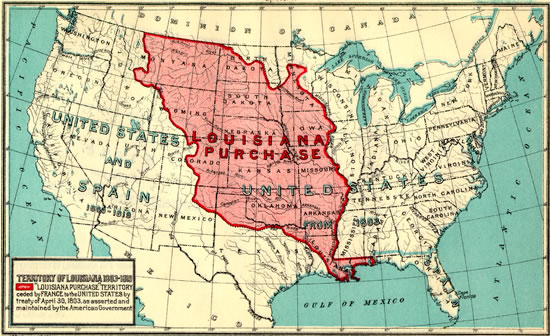
In a ceremony on Dec. 20, 1803, the French turned Louisiana over to the United States at The Cabildo which was the seat of colonial government in New Orleans. By a treaty signed on Apr. 30, 1803, the United States purchased from France the Louisiana Territory, more than 2 million sq km (800,000 sq mi) of land extending from the Mississippi River to the Rocky Mountains, which doubled America’s size. The price was 60 million francs, about $15 million; $11,250,000 was to be paid directly, with the balance to be covered by the assumption by the United States of French debts to American citizens.
In 1762, France had ceded Louisiana to Spain, but by the secret Treaty of San Ildefonso (1800) the French had regained the area. Napoleon Bonaparte (the future Emperor Napoleon I) envisioned a great French empire in the New World, and he hoped to use the Mississippi Valley as a food and trade center to supply the island of Hispaniola, which was to be the heart of this empire. First, however, he had to restore French control of Hispaniola, where Haitian slaves under TOUSSAINT L’OUVERTURE had seized power (1801; see HAITI). In 1802 a large army sent by Napoleon under his brother-in-law, Charles Leclerc, arrived on the island to suppress the Haitian rebellion. Despite some military success, the French lost thousands of soldiers, mainly to yellow fever, and Napoleon soon realized that Hispaniola must be abandoned. Without that island he had little use for Louisiana. Facing renewed war with Great Britain, he could not spare troops to defend the territory; he needed funds, moreover, to support his military ventures in Europe. Accordingly, in April 1803 he offered to sell Louisiana to the United States.
An enormous tract of land was now open to settlement, and the free navigation of the Mississippi was assured. Although the Constitution did not specifically empower the federal government to acquire new territory by treaty, Jefferson concluded that the practical benefits to the nation far outweighed the possible violation of the Constitution. The Senate concurred with this decision and voted ratification on Oct. 20, 1803. The Spanish, who had never given up physical possession of Louisiana to the French, reluctantly did so in an earlier ceremony at New Orleans on Nov. 30, 1803.

Happy Bill of Rights Day

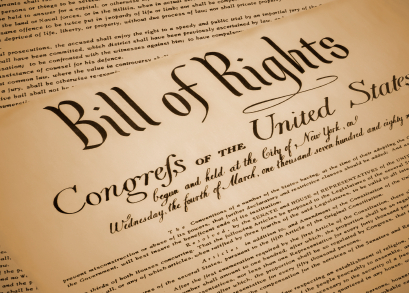
Today is Bill of Rights Day. To Americans, the Bill of Rights are key amendments to the U.S. Constitution, that protect our individual rights.
On March 4, 1789, the Constitution of the United States of America was ratified by the (former) 13 colonies, and went into effect. States and individuals were concerned that the Constitution did not properly cover and protect a number of natural rights of individuals. The Constitution was signed by the original 13 states with the requirement, or understanding, that a Bill of Rights would be created, amending the new U.S. Constitution.
On September 25, 1789, the First Congress of the United States proposed to the state legislatures 12 amendments to the Constitution. 10 of these amendments were added to the Constitution on December 15, 1791.
Read More

Remembering the USS West Virginia


On Sunday, December 7, 1941, the USS West Virginia (BB-48) lay moored outboard of Tennessee (BB-43) at berth F-6 with 40 feet of water beneath her keel. Shortly before 0800, Japanese planes, flying from a six-carrier task force, commenced their well-planned attack on the Fleet at Pearl Harbor. West Virginia took five 18-inch aircraft torpedoes in her port side and two bomb hits those bombs being 15-inch armor-piercing shells fitted with fins. The first bomb penetrated the superstructure deck, wrecking the port casemates and causing that deck to collapse to the level of the galley deck below. Four casemates and the galley caught fire immediately, with the subsequent detonation of the ready-service projectiles stowed in the casemates.
The second bomb hit further aft, wrecking one Vought OS2U Kingfisher floatplane atop the “high” catapult on Turret III and pitching the second one on her top on the main deck below. The projectile penetrated the 4-inch turret roof, wrecking one gun in the turret itself. Although the bomb proved a dud, burning gasoline from the damaged aircraft caused some damage.
The torpedoes, though, ripped into the ship’s port side; only prompt action by Lt. Claude V. Ricketts, the assistant fire control officer who had some knowledge of damage control techniques, saved the ship from the fate that befell Oklahoma (BB-37) moored ahead. She, too, took torpedo hits that flooded the ship and caused her to capsize.
Instances of heroic conduct on board the heavily damaged battleship proliferated in the heat of battle. The ship’s commanding officer, Capt. Mervyn S. Bennion, arrived on his bridge early in the battle, only to be struck down by a bomb fragment hurled in his direction when a 15-inch “bomb” hit the center gun in Tennessee’s Turret II, spraying that ship’s superstructure and West Virginia’s with fragments. Bennion, hit in the abdomen, crumpled to the deck, mortally wounded, but clung tenaciously to life until just before the ship was abandoned, involved in the conduct of the ship’s defense up to the last moment of his life. For his conspicuous devotion to duty, extraordinary courage, and complete disregard of his own life, Capt. Bennion was awarded a Medal of Honor, posthumously.
West Virginia was abandoned, settling to the harbor bottom on an even keel, her fires fought from on board by a party that volunteered to return to the ship after the first abandonment. By the afternoon of the following day, December 8, the flames had been extinguished. The garbage lighter, YG-17, played an important role in assisting those efforts during the Pearl Harbor attack, remaining in position alongside despite the danger posed by exploding ammunition on board the battleship.
Later examination revealed that West Virginia had taken not five, but six, torpedo hits. With a patch over the damaged area of her hull, the battleship was pumped out and ultimately refloated on May 17, 1942. Docked in Drydock Number One on 9 June, West Virginia again came under scrutiny, and it was discovered that there had been not six, but seven torpedo hits.
During the ensuing repairs, workers located 70 bodies of West Virginia sailors who had been trapped below when the ship sank. In one compartment, a calendar was found, the last scratch-off date being December 23. The task confronting the nucleus crew and shipyard workers was a monumental one, so great was the damage on the battleship’s port side. Ultimately, however, West Virginia departed Pearl Harbor for the west coast and a complete rebuilding at the Puget Sound Navy Yard at Bremerton, Wash.
The USS West Virginia was commissioned on December 1, 1923, under command of Capt. Thomas J. Senn. This was the last American Battleship to be launched prior to the restrictions imposed by the 1922 Washington Conference on Limitation of Naval Armament. For the complete history of this historic vessel, visit www.usswestvirginia.org

Happy Thanksgiving

Whereas both Houses of Congress have, by their joint committee, requested me “to recommend to the people of the United States a day of public thanksgiving and prayer, to be observed by acknowledging with grateful hearts the many and signal favors of Almighty God, especially by affording them an opportunity peaceably to establish a form of government for their safety and happiness”:
Now, therefore, I do recommend and assign Thursday, the 26th day of November next, to be devoted by the people of these States to the service of that great and glorious Being who is the Beneficent Author of all the good that was, that is, or that will be; that we may then all unite in rendering unto Him our sincere and humble thanks for His kind care and protection of the people of this country previous to their becoming a nation; for the signal and manifold mercies and the favorable interpositions of His providence in the course and conclusion of the late war; for the great degree of tranquillity, union, and plenty which we have since enjoyed; for the peaceable and rational manner in which we have enabled to establish constitutions of government for our safety and happiness, and particularly the national one now lately instituted; for the civil and religious liberty with which we are blessed, and the means we have of acquiring and diffusing useful knowledge; and, in general, for the great and various favors which He has been pleased to confer upon us.
And also that we may then unite in most humbly offering our prayers and supplications to the great Lord and Ruler of Nations, and beseech Him to pardon our national and other transgressions; to enable us all, whether in public or private stations, to perform our several and relative duties properly and punctually; to render our national government a blessing to all the people by constantly being a government of wise, just, and constitutional laws, discreetly and faithfully executed and obeyed; to protect and guide all sovereigns and nations (especially such as have shown kindness to us), and to bless them with good governments, peace, and concord; to promote the knowledge and practice of true religion and virtue, and the increase of science among them and us; and, generally, to grant unto all mankind such a degree of temporal prosperity as He alone knows to be best.
Given under my hand, at the city of New York, the 3d day of October, AD 1789
George Washington

The Purple Donkephant Fundraiser

Announcing the Purple Donkephant – A collection of wayward items from supporters of the Constitution Party of West Virginia and made available to the public as a fundraising project for “Principles over Politics.” Items can be shipped at cost or picked up at one of our meetings. For more information or to donate your own items, call our hotline at (304) 591-7076 or contact the fundraising committee at PurpleDonkephant@gmail.com. Read More

Welcome New CPWV Officers

The CPWV is pleased to announce its new slate of State Officers for the 2012-2013 term. At yesterday’s meeting in Weston, in the shadows of one of our state’s famous landmarks, the party unanimously elected the following officers:
Brenda Donnellan – Chairwoman
Jeff Becker – Secretary, National Committeeman
Jeffrey-Frank..Jarrell – Vice-Chairman, National Committeeman
Denzil Sloan – National Committeeman
Gene Stalnaker – Treasurer
Betty Quintana (not pictured) – Trustee
Read More

CPWV Platform Position on Education Adopted

At the November 12, 2011 State Party meeting, officers of the CPWV adopted the following platform on Education:
Thomas Jefferson once said, “If a nation expects to be ignorant and free, in a state of civilization, it expects what never was and never will be.” A well educated and inquisitive public is essential to an informed electorate which is then capable of defending our liberties and maintaining our American way of life.  John Milton, author of the classic Paradise Lost, said “The end of all learning is to know God, and out of that knowledge to love and imitate Him.” Thus the mark of a quality education is that it inspires lifelong scholarship and devotion to the tenets of our Creator.  This begins in childhood with elementary lessons preparatory to a broadened high school curriculum, and is then refined to meet piqued interests and aspirations via vocational, college and university plans of study.  Ideal voters are thus those who have become self-learners instilled with a passion for knowledge and who look to numerous sources to quench their thirst for truth and understanding.
Because it is public education which, through taxation, statutes, bureaucracy, and elected school boards, finds itself in the political arena, this is where the CPWV takes its strongest interest.  We also seek to protect the rights of private, parochial, and homeschoolers, as well as promote the use of public libraries, museums, and historical sites as places of learning.  Since Article XII § 1 of the West Virginia State Constitution mandates that “the legislature shall provide, by general law, for a thorough and efficient system of free schools,” public education in our state must accurately reflect each of the key words of this requirement.
Legislature: The word “legislature” specifically refers to the West Virginia State Legislature which is presently comprised of one hundred and thirty-four duly elected State Delegates and Senators.  Our legislature does not include any members of federal Congress or any employees of any federal, non-governmental, or international agencies.  Thus, by law, only Mountain State residents may have any control over our educational process.  According to the 10th Amendment, “The powers not delegated to the United States by the Constitution, nor prohibited by it to the States, are reserved to the States respectively, or to the people.” The federal Department of Education is without authority here and all mandates from it, its deceptively named sub-agencies such as the proposed Office of Rural Education, or any other outside groups are without force.
Provide: The word “provide” means to make available for voluntary use.  It does not mean to force or coerce which is the action of tyrants.  And, because learning requires an open and receptive mind, effective education cannot be forced upon our youth.  The natural law of our Creator assigns the authority and responsibility of educating children to their parents.  So that parents need not defy conflicting statutory law by refusing to send their children to schools of which they disapprove, compulsory attendance laws, and especially those for preschool and kindergarten, should be repealed.  Another reason for repealing compulsory attendance laws is that, much like perishable food which will spoil if not eaten, it is wasteful of public funds to attempt to provide education to those who would refuse it.  Therefore, public education should only be maintained for children who enter the classroom prepared to learn.  This preparedness is the onus of the parent/guardian who must ensure that their children arrive at school with a motivated interest in learning.  Because of this key symbiotic parent-child relationship, we hold that the concept of education as a fundamental right is patently erroneous and it has no constitutionally preferred status.
General Law: The term “general law” refers to public legislation which becomes statutory law in the form of West Virginia Code.  In order to be lawful, these new written edicts may not conflict with the natural law of our Creator or the organic structure or protected rights of our Constitution.  The “general” nature of these laws signifies that they leave room for development and implementation at the county level, establish basic educational expectations, and allow teachers to independently instruct and train their pupils without micromanagement.
Thorough: The word “thorough,” being the first adjective for “system,” refers to the curriculum of a comprehensive and well rounded education.  The CPWV holds that a thorough education is a broad one which consists of the following eight academic characteristics:
1)      Reading is paramount.  The road to education lay through great books.  No man is educated unless he is acquainted with the masterpieces of his tradition – books that have endured.  The wisdom that lies in the works of the world’s greatest thinkers is to be captured and brought to bear on modern society’s problems.  However, revision of literature, for the sake of readability (including condensed versions), ostensibly for young readers, is an Orwellian danger.  A curious reader is a life-long self learner.
2)      Writing and grammar skills come from reading experience.  Compositional ability is directly connected to the quality, quantity, and variety of books read.  Thus, hand-written essays and book report assignments should be expanded.  Also, foreign languages, studies which strengthen ones understanding of their own tongue, should be emphasized; particularly the romance languages and Latin.
3)      Mathematics and the analytical sciences are crucial to the development of critical thinking skills.  Problem solving without electronic devices should be the emphasis of basic algebra, geometry, trigonometry, chemistry, and physics.  Real laboratory experiments should be reinstated without fear of lawsuits.
4)      Comprehensive health education should include courses in biology, botany, and nutrition with sex education confined to the study of basic anatomy and pathology rather than social issues.  Earth sciences and ecology should be taught with respect to man as the dominant species.
5)      In his 1788 book On the Education of Youth in America, Noah Webster said “Every child in America should be acquainted with his own country. He should read books that furnish him with ideas that will be useful to him in life and practice. As soon as he opens his lips, he should rehearse the history of his own country.” American history and civics should include basic law and political content and must replace “social studies.”  Geography, world, European, ancient, and West Virginia history should be interwoven into these studies.
6)      Learning to speak properly and effectively deliver an oral message is something which forces the student to simultaneously develop a strong command of his language as well as the detail subject matter.  It also instills self confidence and improves social skills.  An increase in student presentations and class debates with attention to forensics and reasoning are suggested ways to improve proficiency in this area.
7)      All teaching is related to basic assumptions about God and man.  Education as a whole, therefore, cannot be separated from religious faith.  In fact, public education began so that people could read the Bible on their own.  A Biblical foundation, which is the basis for our laws and civil rights, should be a part of the curriculum, even if at least as literature.  School prayer and invocations at sporting events should be permitted at the option of local school boards.
8)      Consensus and leadership workplace skills should be left to parents and civic groups such as scouting, 4H, and church groups.  This includes the curbing of compelled fundraising.
Efficient: The word “efficient,” being the second adjective for “system,” refers to the intensity of the curriculum and the management of its administration.  First and foremost, the myriad of distractions in today’s schools must be eliminated.  These include all personal electronic devices (zero tolerance), Channel 1, daytime extracurricular activities, and excessive student interaction.  Where possible, pupils should be separated by gender and coed physical education should be prohibited.  To keep focus on the teacher and students on task, desks should be arranged not in distracting groups, but in rows (by random seating) or, even better, in cubicles.  Computers should be kept in a designated area for research and scholastic purposes only.  Since unruly and discourteous students are disruptive to the learning environment, corporal punishment must be reinstated and judiciously used as it is in twenty-two other states.  We entertain a return of the reform school as a discipline measure.  Because self respect is a prerequisite to respect for others, particularly teachers, obnoxious attire, hair, and jewelry should be abated through the implementation of simple dress codes.  Federal government control of education is inefficient as well as unconstitutional.  Thus it is that we seek local school control beginning with parents, school administration and then the county authority.  To better understand their school issues, we encourage parental attendance in the classroom.
System: The word “system” refers to the pedagogy of the individual schools.  It is the specific instructional methodology that prepares adolescents for adult life – the “learning ladder” to success.  We strongly oppose Global21 agenda outcome based education and reject teaching to standardized tests where test results are tied to funding.  The real purpose of testing is for teacher evaluation to improve the instructional method.  Recognizing that the bell curve is natural and some students will excel while others will not, we favor replacing, after the elementary level, age-based classes with ability-based training.  Most lessons should be textbook based rather than group-think consensus projects.  Guidance counseling for career-based course selection needs to be expanded at the middle school level, not earlier, with emphasis on college preparatory, professional, and vocational decision paths.  We are adamantly opposed to the consolidation of school districts and aver that individual counties have ultimate administrative and supervisory authority, not the state or regions via centralized power.  Under no circumstances should the federal government be involved in national teacher certification, educational curricula, textbook selection, learning standards, comprehensive sex education, or psychological/psychiatric research testing programs.
Free: The word “free,” as an adjective for schools, has several meanings among which are: no direct costs, open to children of all demographics, and unencumbered by government bureaucracy.  Financially, since it is largely property taxes which fund our schools through socialistic wealth redistribution, the public deserves to get its money’s worth.  Since academic performance has been on the decline in America since the 1980s, it is clear that progressive increases in technology spending have not been good value.  The proliferation of computers, smart boards, and other devices in the classroom is more distraction than instruction.  School monetary focus needs to be on basics like maintaining attractive teacher salaries and making sure that each student has their own subject textbook rather than relying only on classroom sets.  Allocated spending which results in expensive unused books and canned teaching materials should be eliminated.  Assistance to low-income families in meeting school supply or nutrition needs must be borne by charity.  As long as totally free from federal subsidies, we support equitable local tax relief or voucher programs for families whose children do not attend government schools.  Additionally, the public has the right to access, for the purpose of lawful public assembly and with reasonable use policy, school facilities after regular hours.
Schools: The word “schools” refers to places of academic learning where the purpose is intellectual development, not social pleasure.  Our system of public education was not created for entertainment or free day care purposes.  We reject the idea of schools as the cultural hub of a community.  All extracurricular non-academic activities must be held after school and either privately funded or turned over to other local civic groups.  So called “work enrichment” experience programs are nothing more than shameful compulsory volunteerism which promotes the odious global agenda and should be abolished.  Youth who are not interested in developing their mental acumen need not attend our public schools.
The reduction of a citizen to an object of propaganda, private and public, is one of the greatest dangers to our Republic.  A prevalent notion is that the great mass of the people cannot understand and cannot form an independent judgment upon any matter; they cannot be educated, in the sense of developing their intellectual powers, but they can be bamboozled.  The reiteration of slogans, the distortion of the news, the great storm of propaganda that beats upon the citizen twenty-four hours a day all his life means either that democracy must fall prey to the loudest and most persistent propagandists or that the people must save themselves by strengthening their minds so that they can appraise the issues for themselves.  Thus it is that we support the unimpeded right of parents to provide for the education of their children in the manner they deem best, including home, private or religious.  We oppose all legislation from any level of government that would interfere with or restrict that liberty.