 On June 18, 1812, the United States stunned the world by declaring war on Great Britain.
Supporting its allies in Spain and Portugal, Britain’s army was on the Iberian Peninsula, involved in a struggle with Napoleon Bonaparte, who had marshaled the forces of Revolutionary France under his penumbra.
Despite losing the Thirteen Colonies to George Washington and the American revolutionaries twenty-five years earlier, England, like many on the European continent, did not take the United States that seriously. Despite the fact that most of Britain’s supplies for the Napoleonic war came from America and Canada -from beef to feed the Duke of Wellington’s army, to the oak trees essential to maintain Britain’s majestic navy. Britain found itself faced with another war, a war they had assiduously tried to avoid.
The ostensible reasons for the war seemed to have been forgotten once the opening shots were sounded. The United States was upset at the British navy’s arrogance on the high seas. Desperate to find sailors for a fleet of over one thousand ships, Great Britain didn’t hesitate to stop and search American ships in the hopes of recovering seaman who deserted the draconian existence of the British navy for the easier life aboard U.S. vessels. British captains were not above press-ganging the odd American while they were at it. England had also begun to seize Yankee ships trading with Napoleonic France. These tactics caused a huge controversy in the American Congress. Eventually, the United States cut off all trade with the continent.
As the record reveals, the Americans wanted more than just maritime rights. What they also wanted was the other half of the North American continent still in the hands of the King of England. In 1778, during the American Revolution, the Yankees tried to seize Canada, and actually captured Montreal. The expedition however, under Generals Richard Montgomery and Benedict Arnold, perished in the sub-zero cold beneath the towering walls of the fortress at Quebec.
In 1812, Americans were determined to make another attempt at eradicating the British presence in North America, and settle “the Indian question” once and for all. Such a campaign, promised Thomas Jefferson, would be a matter of mere marching. In Congress, the War Hawks took up this position and demanded the United States finalize the independence from Britain they had fought so hard to win. Many Americans came to see the 1812 conflict as the second Revolutionary War.
When Great Britain finally realized that the Americans would go to war on the impressment issue, it revoked the Orders-in-Council which authorized the seizures. In the final analysis, these causes bore so little weight, that they were not even mentioned in the peace treaty which, eventually ended the war. But in early 1812, it was too late. War was imminent, and could would not be stopped.
June 26 Meeting in St. Albans
 The next state Executive Committee meeting of the CPWV will be held Saturday, June 26, 2010 at the Shoney’s Restaurant in St. Albans, WV from 12:00 noon to 2pm. Read More
The Battle of Bunker Hill
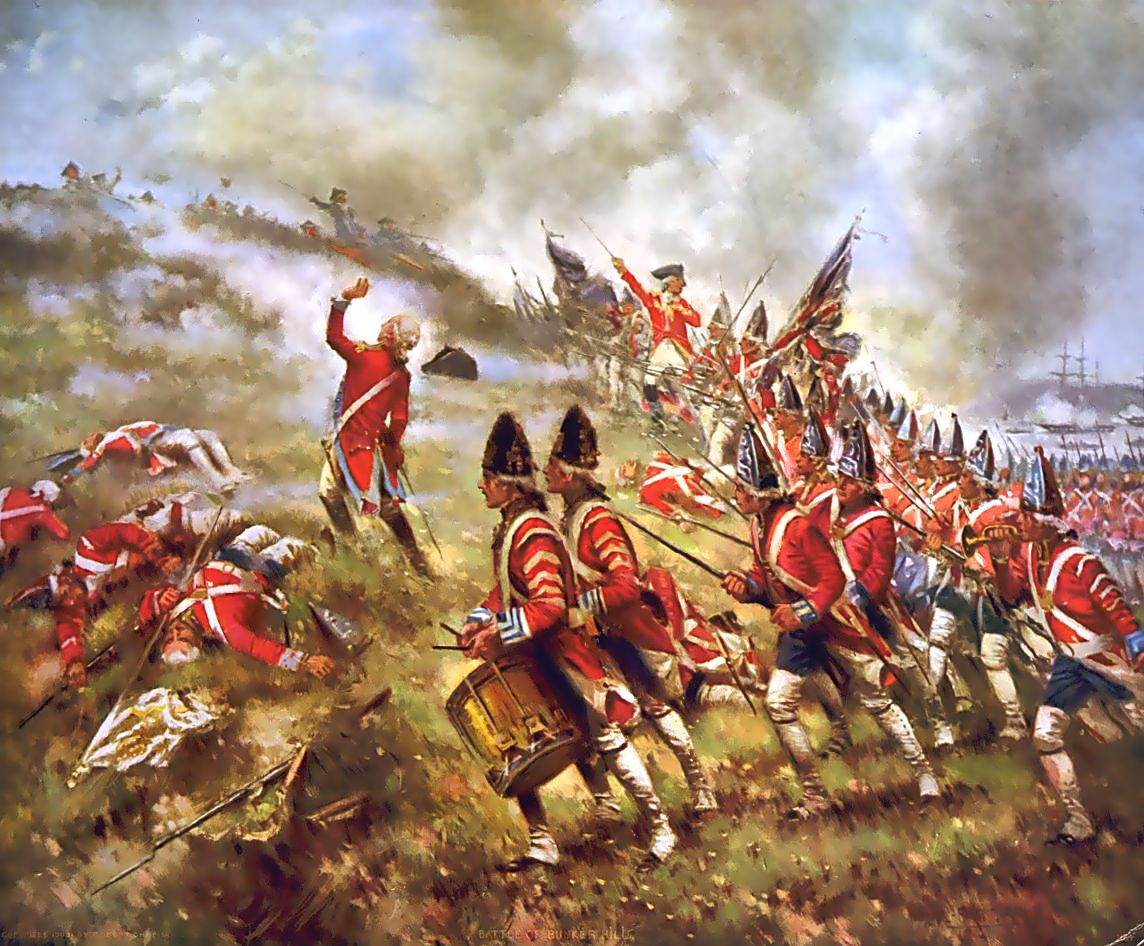 The sun was shining from a cloudless sky a little past noon on June 17, 1775 when a British force of 1500 men landed on Charlestown Heights in Massachusetts. Their objective: a surprise attack to nullify the threat posed by “rebel” batteries on the peninsula.
However, the night before for nearly twelve hours the Americans had worked non-stop building their main fortification on Breed’s Hill which lay at the foot of Bunker Hill to the north.
At daybreak on the 17th gazing through the morning fog, British General Howe was astonished to see a six-foot high earthwork a mushroom fortress that seemingly appeared overnight. “The rebels,” he exclaimed, “have done more work in one night than my whole army would have done in one month.” British cannons immediately opened fire from the ships offshore but the patriots continued work on the intrenchments without harm.
By mid-afternoon General Howe ordered his troops to advance and open fire. As the British moved forward, the Americans remained as silent as the tomb. “Don’t fire until you see the whites of their eyes,” was the order passed along the lines. When that moment came, the word “FIRE!” was shouted, and whole enemy platoons were mowed down and shattered, retreating to the foot of the hill.
Howe rallied his forces and repeated the attack with the same crushing results. Not to be discouraged, Howe rallied his men a third time, ordering them to use only their bayonets. After a desperate hand-to-hand struggle, the Americans were driven out.
In that final assault American General Joseph Warren and British Major John Pitcairn were killed. While the exact number of casualties varies among historians, the Americans were estimated at 441 killed and wounded… with the British casualties at 1,150 killed and wounded.
In all of the twenty battles of the Revolution, Bunker Hill exacted a heavy toll on British officers. In this one battle alone one-eighth of the British officers in the entire War were killed and one-sixth were wounded on that day.
Following the earlier skirmishes at Lexington and Concord, the battle of Bunker Hill was significant in that it overruled any real hope of conciliation. The outcome of the battle rallied the colonies and moved a lethargic Congress to take action. Bunker Hill showed the Americans that the British were not invincible. It showed the British Government that the “rebels” were a serious opponent, that “the mightiest army in all of Europe” had a real fight on its hands.
Washington Commissioned as Commander of Continental Army
 The Journals of the Continental Congress report that George Washington was unanimously selected as Commander in Chief of the Continental Army on June 15, 1775. In a speech given to the Continental Congress on June 16, Washington accepted the commission and requested that he not receive a salary for his service, only that his expenses be paid at the conclusion of the war. On June 17, the Continental Congress drafted Washington’s commission as commander in chief.
The Letters of Delegates to Congress contains a letter that George Washington wrote to Martha Washington on June 18, 1775, after receiving word of his commission as Commander in Chief. Washington announced that the “whole army raised for the defense of the American Cause shall be put under my care, and that it is necessary for me to proceed immediately to Boston to take upon me the Command of it. You may believe me my dear Patsy, when I assure you in the most solemn manner, that, so far from seeking this appointment, I have used every endeavor in my power to avoid it.” The Letters of Delegates to Congress also contains a letter that John Adams sent to Abigail Adams stating, “I can now inform you that the Congress have made Choice of the modest and virtuous, the amiable, generous and brave George Washington Esqr., to be the General of the American Army, and that he is to repair as soon as possible to the Camp before Boston.”
The Continental Congress commissioned George Washington as Commander in Chief of the Continental Army on June 19, 1775. Washington was selected over other candidates such as John Hancock based on his previous military experience and the hope that a leader from Virginia could help unite the colonies. Washington left for Massachusetts within days of receiving his commission and assumed command of the Continental Army in Cambridge on July 3, 1775. After eight years of war, Washington resigned his commission as Commander in Chief on December 23, 1783.
Ben Franklin Flies a Kite
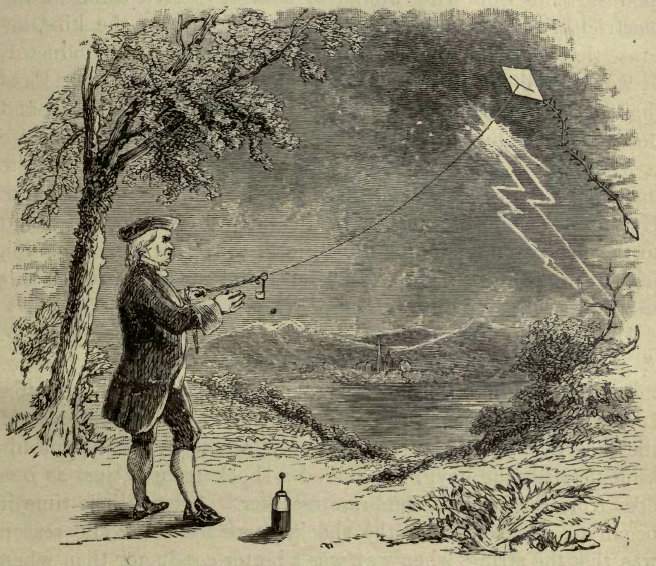 On June 15, 1752, Benjamin Franklin may have possibly conducted his famous kite experiment in Philadelphia; successfully extracted sparks from a cloud, although there are theories that suggest he never performed the experiment. Franklin’s experiment was not written up until Joseph Priestley’s 1767 History and Present Status of Electricity; the evidence shows that Franklin was insulated (not in a conducting path, since he would have been in danger of electrocution in the event of a lightning strike). Others, such as Prof. Georg Wilhelm Richmann of Saint Petersburg, Russia, were electrocuted during the months following Franklin’s experiment.
In his writings, Franklin indicates that he was aware of the dangers and offered alternative ways to demonstrate that lightning was electrical, as shown by his use of the concept of electrical ground. If Franklin did perform this experiment, he may not have done it in the way that is often described, flying the kite and waiting to be struck by lightning, as it could have been dangerous. The popular television program MythBusters simulated the alleged “key at the end of a string” Franklin experiment and established with a degree of certainty that, if Franklin had indeed proceeded thus, he would undoubtedly have been killed. Instead he used the kite to collect some electric charge from a storm cloud, which implied that lightning was electrical.
On October 19 in a letter to England explaining directions for repeating the experiment, Franklin wrote:
When rain has wet the kite twine so that it can conduct the electric fire freely, you will find it streams out plentifully from the key at the approach of your knuckle, and with this key a phial, or Leiden jar, maybe charged: and from electric fire thus obtained spirits may be kindled, and all other electric experiments [may be] performed which are usually done by the help of a rubber glass globe or tube; and therefore the sameness of the electrical matter with that of lightening completely demonstrated.
Franklin’s electrical experiments led to his invention of the lightning rod. He noted that conductors with a sharp rather than a smooth point were capable of discharging silently, and at a far greater distance. He surmised that this knowledge could be of use in protecting buildings from lightning by attaching “upright Rods of Iron, made sharp as a Needle and gilt to prevent Rusting, and from the Foot of those Rods a Wire down the outside of the Building into the Ground;…Would not these pointed Rods probably draw the Electrical Fire silently out of a Cloud before it came nigh enough to strike, and thereby secure us from that most sudden and terrible Mischief!” Following a series of experiments on Franklin’s own house, lightning rods were installed on the Academy of Philadelphia (later the University of Pennsylvania) and the Pennsylvania State House (later Independence Hall) in 1752.
In recognition of his work with electricity, Franklin received the Royal Society’s Copley Medal in 1753 and in 1756 he became one of the few 18th- century Americans to be elected as a Fellow of the Society. The cgs unit of electric charge has been named after him: one franklin (Fr) is equal to one statcoulomb.
Hudok: Feds trying to control public education
By ANTHONY GAYNOR, Staff Writer, The Inter-Mountain
POSTED: April 7, 2010
Pickens School Teacher Phil Hudok has concerns that the federal government is trying to take over the public education system.
“This is public education right here,” Hudok told the Randolph County Board of Education on Monday. “I am speaking for teachers, the public and parents.”
Hudok cited several news articles he said lead him to believe the federal government is overstepping its bounds to controlling public education. He cited one news story in which Gov. Joe Manchin said he would not rule out calling lawmakers into special session to ensure the state qualifies for federal funding.
“It says our state is looking for a way to get money that was taken from the people,” Hudok said. “The federal government should have no control in public education.”
Hudok also cited another news article published on cnsnews.com titled “Obama’s Safe Schools Czar Advocated ‘Queering in Elementary Education.'” Hudok read a portion of the article and said Obama’s appointed Safe Schools Czar Kevin Jennings wrote the forward to a book that includes teaching sexuality to grade school children.
“I don’t like to talk about this stuff,” Hudok said. “This is a book our safe school czar wrote a forward for.”
Hudok said he would bring more information to the board at a later date.
“I think what I have given you is evidence this is happening,” he said.
The board also heard a report from Randolph County Schools Finance Director Brad Smith concerning the 2009 audit report.
He said the auditors had no findings after completing their audit.
The board took action on several items including the transfer/sale of property known as the Laurel Hill School lot. Randolph County Superintendent of Schools Dr. James Phares said the company building the windmills near Laurel Mountain discovered a deed that conveys property to the board for construction of a school. Phares recommended that the board initiate a quitclaim process on the property. This will give 30 days public notice to ensure no one has a claim to the property. After the 30-day period, the school system will auction the property.
ORIGINAL ARTICLE AT: http://theintermountain.com/page/content.detail/id/527914.html
The U.S. Army is Born
 June 14, 1776 is when Congress adopted “the American continental army” after reaching a consensus position in The Committee of the Whole. This procedure and the desire for secrecy account for the sparseness of the official journal entries for the day. The record indicates only that Congress undertook to raise ten companies of riflemen, approved an enlistment form for them, and appointed a committee (including Washington and Schuyler) to draft rules and regulations for the government of the army. The delegates’ correspondence, diaries, and subsequent actions make it clear that they really did much more. They also accepted responsibility for the existing New England troops and forces requested for the defense of the various points in New York. The former were believed to total 10,000 men; the latter, both New Yorkers and Connecticut men, another 5,000.
At least some members of Congress assumed from the beginning that this force would be expanded. That expansion, in the form of increased troop ceilings at Boston, came very rapidly as better information arrived regarding the actual numbers of New England troops. By the third week in June delegates were referring to 15,000 at Boston. When on 19 June Congress requested the governments of Connecticut, Rhode Island, and New Hampshire to forward to Boston “such of the forces as are already embodied, towards their quotas of the troops agreed to be raised by the New England Colonies,” it gave a clear indication of its intent to adopt the regional army. Discussions the next day indicated that Congress was prepared to support a force at Boston twice the size of the British garrison, and that it was unwilling to order any existing units to be disbanded. By the first week in July delegates were referring to a total at Boston that was edging toward 20.000. Maximum strengths for the forces both in Massachusetts and New York were finally established on 21 and 22 July, when solid information was on hand. These were set, respectively, at 22,000 and 5,000 men, a total nearly double that envisioned on 14 June.
The “expert riflemen” authorized on 14 June were the first units raised directly as Continentals. Congress intended to have the ten companies serve as a light infantry force for the Boston siege. At the same time it symbolically extended military participation beyond New England by allocating 6 of the companies to Pennsylvania, 2 to Maryland, and 2 to Virginia. Each company would have a captain, 3 lieutenants, 4 sergeants, 4 corporals, a drummer (or horn player), and 68 privates. The enlistment period was set at one year, the norm for the earlier Provincials, a period that would expire on 1 July 1776.
Celebrate Flag Day
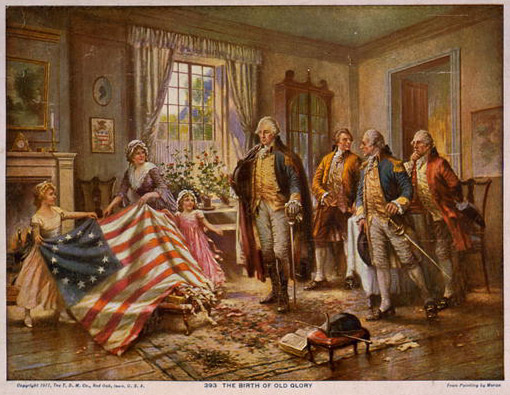 In the United States, Flag Day is celebrated on June 14 to commemorate the adoption of the flag of the United States, which happened that day by resolution of the Second Continental Congress in 1777.
On May 30th, 1916, President Woodrow Wilson issued a proclamation that officially established June 14 as Flag Day; it was not until August 3rd, 1949, that President Truman signed an Act of Congress designating June 14th of each year as National Flag Day, although it is not an official federal holiday.
The Fourth of July was traditionally celebrated as America’s birthday, but the idea of an annual day specifically celebrating the Flag is believed to have first originated in 1885. BJ Cigrand, a schoolteacher, arranged for the pupils in the Fredonia, Wisconsin Public School, District 6, to observe June 14 (the 108th anniversary of the official adoption of The Stars and Stripes) as ‘Flag Birthday’. In numerous magazines and newspaper articles and public addresses over the following years, Cigrand continued to enthusiastically advocate the observance of June 14 as ‘Flag Birthday’, or ‘Flag Day’.
Birthday of A Beautiful Mind
 John Forbes Nash Jr. was born on June 13, 1928 in Bluefield, West Virginia. His father was an electrical engineer and his mother worked as a school teacher. His father gave him scientific volumes to study, while his parents made sure that he received a good education. He became known as an oddball at his school, considering dances, sports, and other social activities to be distractions from his work in scientific study and experimentation. His mother tutored him outside of school, allowing him to skip a grade.
In his senior year of high school, John won a coveted Westinghouse scholarship, one of only ten awarded in the nation. He went to the Carnegie Institute of Technology and, in 1948, graduated with a Master’s degree after only three years. Although he had originally planned to study chemical engineering, he quickly discovered a love for mathematics and changed his major. His advisor wrote a recommendation for him saying “This man is a genius”.
After graduating, John went immediately to Princeton University, where his major accomplishment was to develop his theory of “Nash Equilibrium”, which applied to Game Theory. He rarely attended class, insisting that it would ruin his originality. He constantly looked for ways to establish himself in the field of mathematics in order to become the world’s greatest mathematician. He constantly walked through the hallways whistling Bach’s “Little Fugue” and rode his bicycle in a figure-eight or infinity symbol in the quadrangle on campus.
After he graduated with his Ph.D, John moved to Boston, where he became a distinguished member of the faculty at the Massachusetts Institute of Technology. He was called the “kid professor” by students since he was so young. In 1958, he was featured in Fortune Magazine as one of the brightest stars in the field of mathematics.
He suffered, and has since recovered from schizophrenia. Today, Nash serves in the department of mathematics at Princeton. His life was immortalized in the film “A Beautiful Mind”, with his character portrayed by Russell Crowe.
Second Wheeling Convention Calls for Reorganized Virginia Government
 With the adoption of Virginia’s Ordinance of Secession on May 23, the Second Wheeling Convention began on June 11 as decided at the First Convention. (The First Wheeling Convention was held on May 13 through May 15. Twenty-seven western Virginia counties were represented. Of the 429 delegates who attended, over one-third were from the area around Wheeling. )
The meeting was held in Washington Hall and later the Custom House. The first measures adopted at the Convention ruled that 88 delegates representing 32 counties were entitled to seats in the convention, though other delegates would be accepted later. Arthur I. Boreman was selected to serve as president, and he declared, “We are determined to live under a State Government in the United States of America and under the Constitution of the United States.”
On June 13, John Carlile introduced to the convention “A Declaration of the People of Virginia,” a document calling for the reorganization of the state government on the grounds that Virginia’s secession had in effect vacated all offices of the existing government. Carlile presented an ordinance for this purpose the next day, beginning the debate. Virtually all the delegates at the Convention recognized the differences between eastern and western Virginia as irreconcilable and supported some sort of separation; the disagreement was over how this separation should occur. Dennis Dorsey of Monongalia County called for permanent and decisive separation from eastern Virginia. Carlile, however, though he had called for a similar plan during the First Convention, persuaded the delegates that constitutional restrictions made it necessary for the formation of a loyal government of Virginia, whose legislature could then give permission for the creation of a new state. On June 19, delegates approved this plan unanimously.
The next day, June 20, officials were selected to fill the offices of the Virginia state government (usually called the Restored government of Virginia to avoid confusion with the government meeting in Richmond). Francis Pierpont of Marion County was elected governor. On June 25, the Convention adjourned until Aug. 6.