Phil Hudok, Constitution Party of West Virginia Candidate for the United States House of Representatives, Issues a Challenge to debate.
Huttonsville W.Va. – In order to promote a credible election process of informed voters, Phil Hudok, Second Congressional District Constitution Party candidate, challenges Republican incumbent, Shelly Moore Capito, and Democrat challenger, Virginia Graf, to a public debate.
Read More
November 13 Meeting – Weston

On Sept. 11, the CPWV held it’s 3rd quarter executive committee meeting in Elkins. See the “Meetings” category for the report. Our 4th quarter meeting has been scheduled for Saturday, November 13 at the Steer Steak House in Weston. The meeting will begin at 2:00 and run to approximately 5pm. NOTE: THIS IS A TIME CHANGE FROM EARLIER ANNOUNCEMENT. NOT NOON. TWO (2:00) PM. sorry for any inconvenience.
Read More
Privacy of Petition Signatures?
W.Va. justices hear appeal about petition drives
Wednesday September 8, 2010
by The Associated Press
CHARLESTON, W.Va. — Members of West Virginia’s Supreme Court cited a recent ruling from the nation’s highest court during Wednesday arguments over the Jefferson County clerk’s refusal to release petition drive signatures.
June’s near-unanimous decision allowed the release of petition signatures in Washington state.
Several of the West Virginia justices also referred to a state law that considers any records kept by a county commission as public.
Read More
Constitution Party on ballot for U.S. Senate seat
 09/03/2010
Constitution Party on ballot for U.S. Senate seat
Berkeley Co. resident Jeff Becker says nation needs to return to adhering to document
By MATTHEW UMSTEAD
matthewu@herald-mail.com
MARTINSBURG, W.Va. — Berkeley County resident Jeff Becker, chairman of the Constitution Party of West Virginia, has successfully petitioned to run for the U.S. Senate seat held by the late U.S. Sen. Robert C. Byrd in the Nov. 2 general election.
“He got the required number of signatures. He will be on the ballot,” Jake Glance, spokesman for Secretary of State Natalie Tennant’s office, said Thursday.
A substitute school teacher, Becker, 47, of Inwood, W.Va., said he had about 30 days to obtain 1,756 signatures to get on the ballot as a minor party candidate. He then filed a second petition with 1,740 signatures to get a waiver from having to pay the filing fee.
“It was a lot of work. I went to a lot of county fairs,” said Becker, recalling trips to Lewis, Upshur, Hampshire and Jefferson counties.
When asked why he was running, Becker said the nation needs to return to adhering to the U.S. Constitution.
“The Senate was not supposed to be a third or fourth or fifth representative,” said Becker, who served in the West Virginia Air National Guard for six years. “It’s supposed to represent the (state and their legislatures).”
Becker joins West Virginia Gov. Joe Manchin, the Democratic Party nominee; Morgantown businessman John Raese, the Republican Party nominee; and Mountain Party candidate Jesse Johnson on the ballot.
“The other three candidates are interested in being senators from West Virginia,” Becker said. “I want to be a senator for West Virginia.”
If elected, Becker said he also would represent his party’s seven principles — life, liberty, family, property rights, the U.S. constitution as originally written, states’ rights and American sovereignty.
Among those who signed the petitions, Becker said about half of them indicated they wanted a choice other than the nominees from the Republican and Democratic parties, which he said have been financially irresponsible.
Before running for Senate, Becker said he was a candidate in 2008 for Berkeley County surveyor, a state constitutional office that comes with no official duties or salary. Becker said he received about 9 percent of the vote.
LINK TO ORIGINAL ARTICLE:
http://www.herald-mail.com/?cmd=displaystory&story_id=252210&format=html
September 11 Meeting – Elkins
 The next CPWV meeting will be held Saturday, Sept. 11, 2010 at the Pizza Hut on 1513 Harrison Avenue in Elkins, West Virginia. Harrison Ave. is the main street through Elkins and the Pizza Hut is on the north side of Elkins.
The meeting will run from 12:00 to 5:00 P.M. There will be much to discuss; Agenda to follow.
Read More
Harrison County Formed
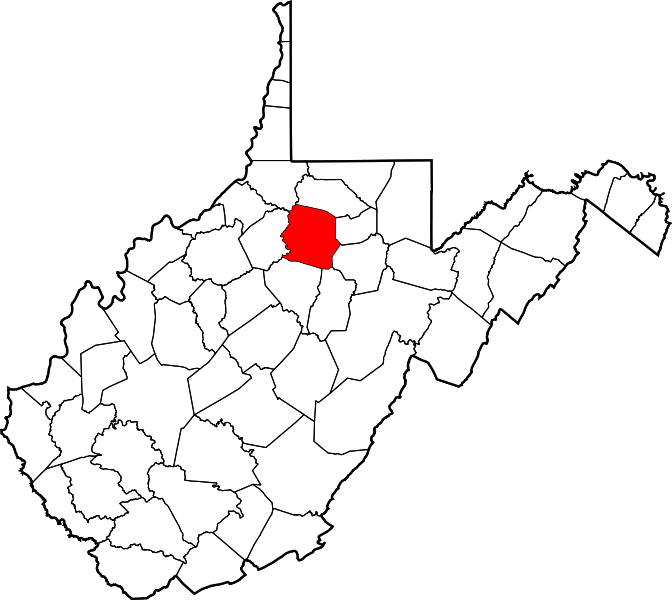 By act of the Virginia Legislature, Harrison County was created on July 20, 1784 from parts of Monongalia County. It was named in honor of Benjamin Harrison who graduated from William and Mary College, served in the Virginia General Assembly and Continental Congress, signed the Declaration of Independence, and served as Governor of Virginia from 1781 to 1784. He was also the father of General William H. Harrison, 9th President of the United States, and the great grandfather of Benjamin Harrison, the 23rd President of the United States.
In 1790, just after Harrison County was formed, it had next to the smallest population (2,080) of the nine counties that were then in existence and fell within the current boundaries of West Virginia. Berkeley County had the largest population (19,713), Randolph County had the smallest population (951), and there were then a total of 55,873 people living within the present state’s boundaries.
The county seat was originally established at the house of George Jackson, at Bush’s Fort on the Buchannon River. The current county seat, Clarksburg, was named for the explorer General George Rogers Clark. John Simpson, ancestor of President and Union Army General Ulysses Simpson Grant, is credited as the town’s first, permanent settler. He arrived in 1765. In 1773, David Davisson claimed 400 acres of land, near present day downtown Clarksburg. The town was chartered by the Virginia General Assembly in October 1785 and was incorporated in 1795. The town’s first newspaper, The By-Stander, began publication in 1810.
Harrison County was the site of numerous battles during the French and Indian Wars (1754-1763), especially around Nutter’s Fort, where Clarksburg now stands, and around West’s Fort, near the present site of Jane Lew. It was also the home of two famous Americans: Confederate General Thomas Jonathan “Stonewall” Jackson, and John William Davis, Democratic nominee for President of the United States in 1924.
Man Lands on Moon
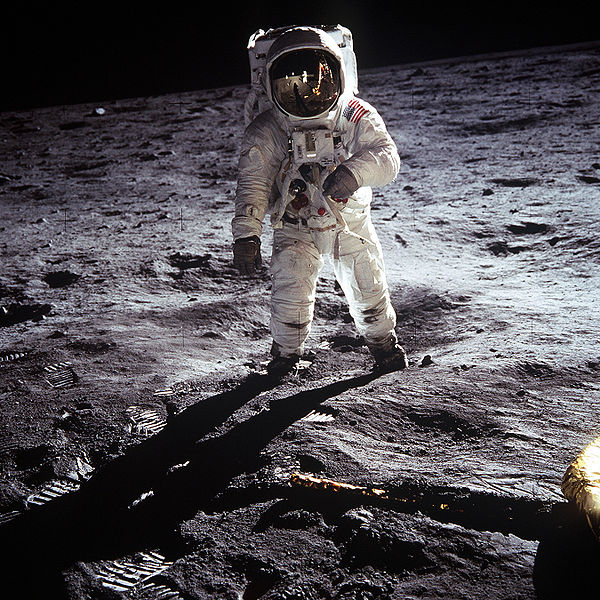
The Apollo 11 space flight landed the first humans on Earth’s Moon on July 20, 1969. The mission, carried out by the United States, is considered a major accomplishment in human exploration and represented a victory by the U.S. in the Cold War Space Race with the Soviet Union.
Launched from Florida on July 16, the third lunar mission of NASA’s Apollo Program (and the first G-type mission) was crewed by Commander Neil Alden Armstrong, Command Module Pilot Michael Collins, and Lunar Module Pilot Edwin Eugene “Buzz” Aldrin, Jr. On July 20, Armstrong and Aldrin landed in the Sea of Tranquility and became the first humans to walk on the Moon. Their landing craft, Eagle, spent 21 hours and 31 minutes on the lunar surface while Collins orbited above in the command ship, Columbia. The three astronauts returned to Earth with 47.5 pounds (21.55 kilograms) of lunar rocks and landed in the Pacific Ocean on July 24.
Apollo 11 fulfilled U.S. President John F. Kennedy’s goal of reaching the moon before the Soviets by the end of the 1960s, which he had expressed during a 1961 mission statement before the United States Congress: “I believe that this nation should commit itself to achieving the goal, before this decade is out, of landing a man on the Moon and returning him safely to the Earth.”
Five additional Apollo missions landed on the Moon from 1969–1972.
Special Election Process In Chaos
 Following days of legislative wrangling over the process to succeed the late Sen. Robert Byrd, state lawmakers in West Virginia still haven’t reached an agreement as Gov. Manchin’s special session has devolved into partisan finger-pointing.
Read More
Mass. may join effort to bypass Electoral College
 The Massachusetts state Legislature is poised to give final approval this week to a new law intended to bypass the Electoral College system and ensure that the winner of the presidential election is determined by the national popular vote.
Read More
Battle of Rich Mountain Concludes
 In the early days of the war between the states, control of transportation routes through western Virginia was a strategic goal of both Union and Confederate planners.
Following their hasty retreat from Philippi in June of 1861, Confederate troops under the command of Col. Robert S. Garnett fortified two key passes. The more southerly of these, Camp Garnett, consisted of earth and log entrenchments overlooking the Staunton-Parkersburg Turnpike at Rich Mountain, just west of Beverly.
Major General George B. McClellan, charged with securing the loyal counties of western Virginia and protecting the area’s vital B & O railroad for the Union, brought over 5000 troops and 8 cannons to Roaring Creek Flats, about 2 miles west of the Camp Garnett entrenchments.
Confederate Lt. Col. John Pegram was in command of Camp Garnett with about 1,300 men and 4 cannons. He sent a small party to protect his rear at the Joseph Hart homestead at the pass where the Pike crossed the summit of Rich Mountain. On the morning of July 11, the force at the pass consisted of 310 men and one cannon.
Meanwhile in the Union camp, General McClellan was hesitant to make a frontal attack on Camp Garnett Joseph Hart’s 22-year-old son, David, volunteered to lead a flank attack to the summit.
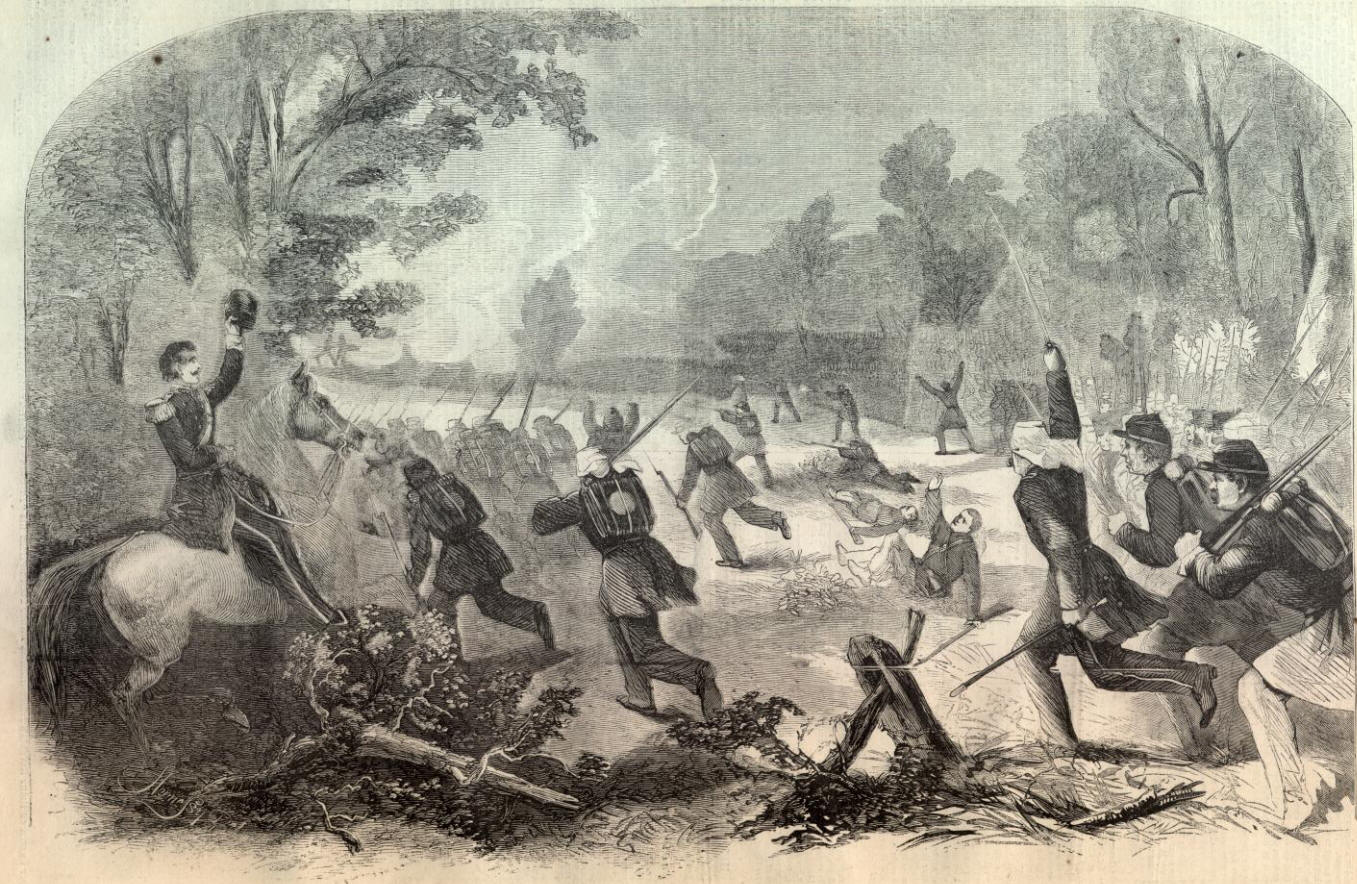
In the early morning of July 11, Brigadier General William S. Rosecrans with almost 2,000 men, set out with young Hart up the mountain. They struggled through the dense woods, delayed by missed directions and drenched by rain.
About 2:30 pm on July 11, the Federal column encountered enemy skirmishers on top of Rich Mountain. The surprised Confederate outpost at the pass took cover behind rocks and trees, and with the help of their one cannon, held off the Federal attack for over two hours. But badly outnumbered, they eventually gave way, and General Rosecrans’ troops took possession of the field.
Colonel Pegram, realizing that the enemy was in his rear, ordered the withdrawal of his remaining forces from Camp Garnett during the night.
On the morning of July 12, 1861, General Rosecrans’ entered the abandoned Camp Garnett from the rear, and sent word to General McClellan that the enemy had been routed. General McClellan promptly sent a telegram to Washington claiming a great victory. This communication secured McClellan’s reputation as a winning general and led to his appointment as commander of the Army of the Potomac.
The Confederates were forced to give up their works at Laurel Hill, and fought a disastrous retreat eastward to Corrick’s Ford and across the Allegheny wilderness. Later, fighting at Cheat Summit prevented any serious Rebel comeback, and battles in the Kanawha Valley claimed even more territory for the Wheeling government. The Federals retained control of most of northwestern Virginia, and except for scattered raids, the Confederacy was banished from the area and its vital railway for the rest of the war.
Two years after the Battle of Rich Mountain, the State of West Virginia was admitted to the Union.